Showing posts with label paperback originals. Show all posts

Thursday, August 18, 2011

All steamed up

As my friend and fellow blogger observed not long ago, “steam is so hot right now.”  This year has seen a mind-boggling number of steampunk-themed events in the northeast alone: International Steampunk City, which took over the town of Waltham for a weekend; a book tour for The Steam­punk Bible; an exhibit on steampunk aesthetic , form, and function at the Charles River Museum of Industry and Innovation; The Steampunk World’s Fair three-day festival in New Jersey…  Whew! And the events just keep on coming, with next week’s performance of Valve: Antique Vaudeville Circus and the Museum of Industry’s ongoing Steampunk Calendar. Entranced by the wide, imaginative (or should I say “re-imaginative”?) world of steampunk, I recently read two short story collections that explore the ever-expanding boundaries of the genre.

In editor Trisha Telep's collection Corsets & Clockwork: 13 Steampunk Romances (Running Press, May), authors such as Caitlin Kittredge, Dia Reeves, Kiersten White, and Adrienne Kress write the steamier side of steampunk, where “technomagical and natural desires collide.” This naturally means lots of flirting and first kisses (with gorgeous automatons or gentlemen criminals, aboard airships, or after narrowly escaping mad inventors); it also entails deeper ethical concerns about technology, progress, and humanity’s impact on nature. Don’t miss contributor Dru Pagliassotti’s excellent essay “How Do I Write a Steampunk Story?” at Steamed!.

Steampunk! An Anthology of Fantastically Rich and Strange Stories edited by Kelly Link and Gavin Grant (Candlewick, October) goes even further in expanding the steampunk oeuvre—but you’ll have to wait for the September/October issue of The Horn Book Magazine to read my review. In the meantime, pilot your airship over to the website for our list of recommended steampunk-inspired reads.

—Katie Bircher

Thursday, June 16, 2011

Thrill-o-RAMA!

Get out your pink boa and sunglasses!


This past Friday the movie Judy Moody and the NOT Bummer Summer, based on the bestselling book series by author Megan McDonald and illustrator Peter H. Reynolds, opened in theaters. Whether or not you had a chance to see it in the theaters this past weekend, here are some tie-ins to get you in a Judy Moody mood.

In late May, Candlewick Press published an original novel by Megan McDonald based on the screenplay she co-wrote with Kathy Waugh. This movie novelization allows devout fans to relive all their favorite moments from the film, and includes eight pages of full-color stills from the movie. After reading this new Judy Moody adventure (which stays true to the series despite lacking Reynolds’ recognizable illustrations), I’m looking forward to seeing the movie myself. I also hear that McDonald and Reynolds are putting the finishing touches on a “classic” version of Judy Moody and the NOT Bummer Summer that will be a forthcoming tenth book in the series.

Additional tie-ins for the movie, all from Candlewick Press:
- an audiobook version of the movie novelization (from Candlewick on Brilliance Audio) performed by Barbara Rosenblat
- a hardcover edition of the Bigfoot Society of America’s official guide So You Want to Catch Bigfoot like the one Aunt Opal gives to Stink in the film
- a hardcover edition of Judy Moody Goes to Hollywood, with a behind-the-scenes look at the making of the movie and on-set photographs
- two easy reader books (Judy Moody and the Thrill Points Race and Judy Moody and the Poop Picnic) featuring vignettes and stills from the film


I gave these books to my sister's niece over Memorial Day weekend, and she was devouring them in the car right afterward. Check them out for the Judy Moody lover in your life—I guarantee he or she will think they are totally rare!

—Cindy Ritter

Thursday, June 9, 2011

Wild rumpus

I can’t draw. You wouldn’t want me on your Pictionary team. I also have a fifteen-month-old, so tushy humor is big right now. For these reasons, Brian Snyder and Alexis Moniello’s Everything Butt Art at the Zoo (Madbrook, May) caught my eye. “What can you draw with a butt? Everything!” Starting with a flattened-looking W (i.e., bum shape), the authors demonstrate, step by step, how to sketch fifteen different zoo animals, from a simple-ish six-step snake to a more involved twelve-step lion. A lot of the fun is seeing where the butt shape will take you; for almost all of the animals, the starting-point wiggly line doesn’t end up forming the rear. Sometimes it’s paws, sometimes cheeks (on the face, that is), sometimes a big, wide grin.


There’s no way kids won’t think this is funny, and it does get them thinking, between giggles, about shapes and forms. The fun continues on the website, and it looks like an app is on the way. Visual art is taken out of the museum and plopped right into the zoo—just where kiddos might want to find it.

—Elissa Gershowitz

Monday, June 6, 2011

The Big Four

I just read Rage by Jackie Morse Kessler (HMH, April), a follow-up to October’s Hunger. In each book, a troubled girl on the brink of killing herself (intentionally or through miscalculated self-injury) is offered a second chance by Death: take on the role of a Horseman of the Apocalypse. Anorexic, over-exercising Lisa becomes the avatar of Famine, and outcast cutter Missy assumes the mantle of War. Their new identities give the teens a sense of purpose, and the power to inflict—or choose not to inflict—tragedy on others inspires Missy and Lisa to confront their personal demons.

There’s an implication in the novels that a “bigger picture” perspective can reverse these extremely complex psychological problems. I doubt that global awareness alone would be enough to change an anorexic's or self-injurer's self-destructive patterns, but it’s refreshing to see protagonists dealing with these issues in plots that go beyond a problem novel set-up. Partial proceeds from the books are donated to the National Eating Disorder Association and self-injury prevention organization To Write Love on Her Arms, two causes I wholeheartedly support.

So far, the Horsemen protagonists have been Horsewomen, with psychological issues primarily (but certainly not only) afflicting teenage girls, but both secondary characters Death and Pestilence have male incarnations. I’m curious about their back stories—particularly that of the enigmatic Pale Rider, who bears an uncanny resemblance to a long-dead icon of the grunge era (complete with a tendency to break into “Come as You Are”)—and interested to see how the change of protagonist gender may influence the narratives. Loss, starring Pestilence, will be out next year; it looks like I’ll have to wait even longer to get the whole scoop on Death.

In the meantime, Kessler’s “characters strike back” in an interview with the author by Missy and Lisa. And Death himself chats about life, “little-d death,” and rock ‘n’ roll with other protagonists of YA novels at the “call-in radio show”–style blog Post Mortem.

—Katie Bircher

ETA: See Jackie Morse Kessler's response to The Wall Street Journal's "Darkness Too Visible" article here

Wednesday, May 25, 2011

Lookin' good

Beauty and makeup how-to books are abundant and ever-popular—makeup artist turned beauty mogul Kevyn Aucoin’s New York Times bestseller Making Faces (Little, Brown, 1997) and his later Face Forward (Little, Brown, 2000) set the bar high. Erika Stalder (with celebrity stylists Christopher Fulton and Cameron Cohen) smartly cashes in on the genre for a young audience with The Look Book: 50 Iconic Beauties and How to Achieve Their Signature Styles (Zest Books, May).

Each spread of The Look Book focuses on a signature look paired with its celebrity innovator, organized into chapters by features of the face. The examples are accompanied by background information on the icon and a discussion of her style, a famous quotation, and her best-known accomplishments, though some of the subjects (silent-movie star Mary Pickford with her “ringlet curls,” for example) may elicit the occasional “who?!” While Aucoin’s books include ordinary women as models in addition to the world-famous, The Look Book sticks with famous faces. Using average teens alongside, let’s say, Brooke Shields to demonstrate “natural, full brows,” would have made these unique styles more relatable and appealing to the intended audience. Regardless, the accompanying instructions are concise, thorough, easy to follow, and include important details such as who each look “works best on,” the “tools needed,” and “time it takes” to create the look. At the heart of the The Look Book are the messages that individuality and an adventurous approach are the keys to iconic beauty, and that having fun with your appearance is what’s most important—sentiments sure to inspire and excite aspiring makeup artists and divas-in-training. Get a sneak peek with Zest’s how-to videos here.

—Katrina Hedeen

Friday, April 15, 2011

"I'll clean up my act when I'm good and ripe!"

Karl Beckstrand's bizarrely funny picture book Bad Bananas (Premio, June) shows how good bananas go wrong. Fresh from the grocery store, they're sweet and "conform nicely to the bunch," but before you know it they're "borrowing" the fruit bowl for joyrides and loitering in "dimly lit lunchboxes." The fair trade and organic labels of their innocent youth are replaced by tattoo-like stickers proclaiming Del Malo, Un-Organic, or Dull. When rival fruits try to stand up to these hoodlums, insults fly: "Your mother's a raisin!" Most of illustrator Jeff Faerber's illustrations style the bad apples bananas as gang-banger types or skate punks—but some go fully Dark Side, like a Darth Vader-ish villain and a pirate banana walking the plank into a frying pan.

Just when you think there's no hope—they're just a bad bunch—salvation appears in the form of banana-based recipes. Cookies, fruit salad, pancakes, and more give these bananas a second chance. I made "banana redemption muffins" (with the "optional" chocolate chips, of course) and brought them into the office. A little dense (probably from my forgetting the baking powder rather than any defect in the recipe), they were still delicious, and an excellent use for the overripe bananas stinking up my kitchen. And while I can't say my baking received "four stars from The Banana Post," I'll take an appreciative "mmm" from The Horn Book staff any day.

—Katie Bircher

Thursday, April 7, 2011

Wimpy Kid and beyond

Rick Detorie’s The Accidental Genius of Weasel High (Egmont, April) comes hot on the heels of the latest movie adaptation of Jeff Kinney’s popular series, Diary of a Wimpy Kid: Rodrick Rules (currently in theaters). This paperback original will appeal to Wimpy Kid fans in both its format and its angsty content. Accidental Genius poses itself as the “notebook blog” (what we called "a journal" in the old days) of protagonist Larkin Pace—a project assigned by his freshman English teacher as a result of the students’ “overall poor writing skills and penmanship.” Larkin chronicles his ninth-grade, girl, and family dramas through witty entries and frequent lists of things he hates, e.g., “Ten Things I Hate About Being 14” and “Top Ten Things That Bug Me About My Dad” (#7 on the Dad list: “He’s old”). Accompanying Larkin’s “blogging” are cartoon illustrations similar in style and sophistication to Detorie’s nationally syndicated comic strip, One Big Happy. Though the drawings enhance the text, they tend to feel like the adult Detorie's art rather than teenage Larkin's personal sketches.

Larkin’s fourteen-year-old ambitions and cynicism will wet the whistles of Wimpy Kid followers who’ve been yearning for more every-kid heroics since the publication last November of Diary of a Wimpy Kid: The Ugly Truth (Amulet). Though Larkin bears more than a passing resemblance to Kinney’s Greg Heffley, Accidental Genius is far from a wimpy addition to pubescent boys’ bookshelves.

—Katrina Hedeen

Thursday, March 17, 2011

Thirsty?

I'm currently appreciating Teeth: Vampire Tales (HarperCollins), an upcoming short story anthology edited by Ellen Datlow and Terri Windling. The big-name contributors such as Neil Gaiman, Ellen Kushner, Holly Black, Tanith Lee, and Garth Nix initially caught my attention, but it's refreshing to find tales by authors I haven't read before (Suzy McKee Charnas, Steve Berman) or haven't read in this genre (Cecil Castellucci, Delia Sherman). With series like Twilight, House of Night, Vampire Academy, Vampire Kisses, and Vampire Diaries running at a minimum of four volumes each (often more like six or seven), sometimes vampire fiction feels as endless and unchanging as its undead protagonists. Short stories by new voices make for a nice change.

The Fledgling Handbook 101 by P.C. Cast and Kim Doner (St. Martin's Griffin) is a "nonfiction" companion to P.C. and Kristin Cast's "vampyre" boarding school series, House of Night. Purportedly a student handbook for incoming first-years (think J.K. Rowling's "textbooks" Quidditch Through the Ages and Fantastic Beasts and Where to Find Them), The Fledgling Handbook covers history of the vampyre race, what to expect during one's vampyre transformation, school rules and traditions. Journal sections allow the student to chronicle accomplishments and adventures while at the school. Cast and Doner create lore for the pseudo-Wiccan magic-wielding vampyres from human history and mythology, recasting monarchs, gods and goddesses, and artists as vampyres. Did you know Cleopatra, Boudicca, and Hippolyta were "Nightkind"? No? What about Cicero, Sappho, and Shakespeare? Clearly you weren't paying attention in world history.

-- Katie Bircher

Monday, March 14, 2011

Cover Girls

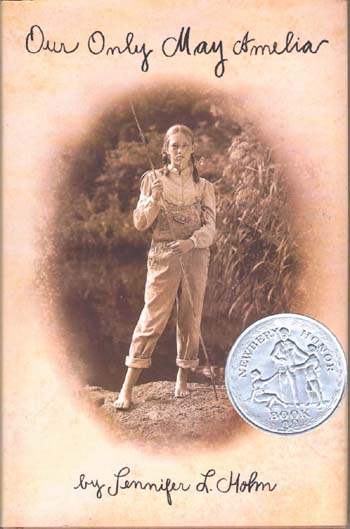
I smiled when I saw Mitali Perkins’s Facebook status update the other day. Apparently it was World Read Aloud Day -- one of those things, like Mitali, that I can usually feel pretty good about (unlike Turn Off Your TV Week or Stop Eating So Much Takeout Month). On World Read Aloud Day I read a chapter of Jennifer L. Holm’s Newbery Honor Book Our Only May Amelia to my ten-year-old daughter. Despite her love for Babymouse, she’d been resisting Holm’s May Amelia because of a preference for contemporary realistic fiction, and the sepia-toned photo of a girl in overalls on the cover just wasn’t cutting it. But she was intrigued when I brought home the sequel, The Trouble with May Amelia (see the May/June Horn Book for the review), with its upbeat color photo of a contemporary-looking girl in overalls (a cover that made me snort, but hey, whatever works, you marketing people). We read it, she loved it, and now we’re making our way through the first book.

What I read to my five-year-old that evening was a little less literary. Visiting the office over school break, she had nabbed a paperback -- Magic Hearts, an entry in Aladdin’s Candy Fairies series by Helen Perelman. The cover picture, a fairy decked out in pink glitter, had caught her eye, natch. Candy Fairies is a dream come true for my kindergartner: fairies and candy, what else is there? Well, those people at Aladdin know what else. “Berry … the Fruit Fairy enjoyed making delicious fruit candies, but she also loved making jewelry. The more sparkle the better! Berry loved anything and everything to do with fashion.” For the five-year-old whose favorite dress-up outfit always includes sparkly rings and fairy wings (and who enjoys watching What Not to Wear, Project Runway, and America’s Next Top Model -- jeez, we do need to turn off that TV), it’s book heaven. And while it’s not great literature, it did make me laugh out loud with this winner of a line: “Raina gasped. ‘Oh, Fruli!’ she exclaimed. ‘You scared the sugar out of me!’” Oh, Fruli, indeed.

-- Jennifer M. Brabander

Friday, March 11, 2011

Celeb BFF wisdom?

Like many children who grew up in the nineties, I know who Elizabeth Berkley is -- she played Jessie Spano on the popular, heavily syndicated Saved by the Bell. So when Ask Elizabeth (Putnam, March) came into the office, I snatched it up out of curiosity (and perhaps fear). As it turns out, it’s getting a lot of attention. It’s an off-shoot of her non-profit workshops and web forum, “Ask Elizabeth,” which aim to promote the well-being of adolescent girls worldwide. The book presents itself as “group diary” and “life handbook for teenage girls,” offering stories, declarations, and questions by teens, and advice from experts and Berkley herself on issues key to a girl’s emotional life: self-esteem, body image, love, loss, friendship, and family. I was skeptical, but Berkley makes for a dependable confidante, and the book covers the topics adequately and creatively. Even the scrapbook-like design is alluring, if a bit difficult to read at times. Yes, I am a softie for girl-power self-esteem boosting (and maybe nineties sitcom stars), but Ask Elizabeth does exactly what it sets out to do, and does it well.

In a kind-of-similar but far more superficial vein, Lo Bosworth (right-hand gal to Lauren Conrad on MTV’s The Hills) poses as a BFF figure and addresses teen self-worth through the lens of boys and relationships in her January paperback release The Lo-Down (Simon). The reading is appropriately light, complete with quizzes, self-esteem–building exercises, and activity ideas. To the audience of Hills fans she’s speaking directly to (or at), Bosworth’s voice will sound cool and cute, her teachings wise and trustworthy. Non-fans, on the other hand, should be wary -- the advice may fall flat if you couldn't care less about the celebutante dishing it out.

-- Katrina Hedeen

Friday, March 4, 2011

Keep your friends close, and your frienemies closer

I have to admit that when I slipped Amy Holder's debut novel The Lipstick Laws (HMH/Graphia, April) off the shelf, I was motivated mainly by the jacket summary's similarity to Mean Girls. Packed with cliques, hot boys, revenge, and a tyrannical friendship pact sealed with a bright red kiss, The Lipstick Laws would be ripe for adaptation as a sequel to the 2004 film -- if ABC Family hadn’t already released Mean Girls 2 in January.

The Lipstick Laws lacks all of the wit of Tina Fey’s script and all of the substance of the movie's nonfiction inspiration, Queen Bees & Wannabes by Rosalind Wiseman. Narrator April Bowers spends most of her time vapidly obsessing over boys and insulting the physical appearance of her classmates, making the reader wonder: what really makes her better than reigning queen Britney Taylor? April is sucked in, chewed up, and spit out by the Lipstick Lawlords, the popular clique headed by Britney. This drives unpopular April to plot a series of humiliating pranks to bring Britney down a notch or two. Though April finds a new group of friends and realizes some of her own shallow faults along the way, by the time she calls off her final prank -- because she realizes it's potentially lethal -- readers will undoubtedly be rooting for everyone involved to sink into high school obscurity.

-- Elizabeth Parks

Monday, January 10, 2011

Newbery shocker!

What?? Glee: The Beginning isn't even an honor book? I know! Shocking. And I wouldn't have even brought it up (mostly because a novel based on a TV show that's successful due to the fabulous musical numbers doesn't have much to offer -- even if it does include a "Gleetastic Poster Inside"), but when we received ALA's spring 2011 graphics catalog in the office, and I saw this:

I remembered that I'd promised Katie I'd write something about the damn book. The trouble is, as much as I love the show (or loved the show -- I think it's lost its way) and the characters, I can't get past the first few pages of the novel. Exhibit A:
"Rachel Berry paused outside the door to Principal Figgin's office just long enough to straighten her kneesocks and smooth down the sides of her corduroy skirt. Her bright white button-down and pink-and-green argyle sweater-vest seemed to scream overachiever..."
I rest my case.

-- Kitty Flynn

Wednesday, December 29, 2010

I thought you would be a children's book

I know we're not supposed to judge by covers and all, but I'm guessing that the publisher BOOM! Town has us mistaken for some other book review journal.

Wednesday, November 24, 2010

Dispatches from Transylvania

"To my son, my husband, and my cell phone." -- iDrakula's dedication

Bekka Black’s new novel iDrakula (Sourcebooks Fire) retells Bram Stoker’s classic epistolary story entirely through digital communication, including text messages, email, and websites. This “e-pistolary” format itself is still unusual, but it’s quickly gaining ground, particularly for teen readers (see Elizabeth Rudnick’s Tweet Heart, published in June).

Black streamlines Stoker’s plot and takes some liberties in recasting his characters. Abraham Van Helsing becomes Abe, a med school cutie, rather than a distinguished professor. Jonathan Harker, as a cheating boyfriend instead of a doting husband, makes way for Mina Murray to pursue a new romance (and steal the limelight). Still, non-purist Stoker fans will enjoy this reimagining as a loving homage to the classic; readers up on their vampire lore will chuckle at allusions like “Tepes Travel” and “Ask Vlad” search engine. As in the original novel, readers must fill in the gaps between communiqués to finish the narrative; what’s left to the imagination can be even creepier than what’s included.

Sourcebook’s iDrakula app for iPhone and iPod Touch manages to fill in some of these gaps without limiting the reader’s interpretation. The app -- a hybrid of e-book, cell phone novel, and radio play -- incorporates the whole text of the novel, plus additional audio of phone calls and voicemails between characters. Content opens day by day for fifteen days to unfold the plot in real time. (Impatient readers can opt to unlock everything at once.) The one-day-at-a-time pacing and the act of scrolling sharpen suspense, though users unfamiliar with the story may be confused by the way some messages open out of order. The blood-spattered, cracked iPhone image of the app lends a sense of foreboding to even innocuous messages.

The app is free to download and sample for the first five days of the novel, but beware: the freebie ends on a cliffhanger.

Like Loser/Queen, it remains to be seen how the paperback itself will fare. Readers who encounter iDrakula in paperback will probably seek out the app for additional content, but I doubt the app with its extras will promote sales of the physical book. I hope that readers thirsty for more after reading Black's retelling in either format will seek out Stoker’s novel (if they haven’t already) to really scare themselves silly.

-- Katie Bircher

Monday, November 15, 2010

Extra points for participation

You may have heard this summer's buzz surrounding Jodi Lynn Anderson’s (bestselling author of Peaches) Loser/Queen (Simon & Schuster), an “interactive” novel for which cyber fans voted weekly on turns in the plot. With the paperback edition’s release date of December 21 approaching, and the ARC landing in the Horn Book offices, I came to wonder if the summer’s hype speaks for anything beyond a very marketable idea.

The story follows Cammy, a typical high school “loser” who has more in common with the grandparents who raise her than she does with her classmates. She begins receiving mysterious text messages revealing secrets that bring down the most popular kids at school, and after a make-over facilitated by her mysterious “White Rabbit” texter, Cammy moves up the social ladder. Though the story of outcast turned teen queen is nothing new, Cammy is relatable -- especially so, I’m sure, to the readers who helped shape her actions online. The fact that these readers’ imaginations helped create the novel will probably make them want to own what feels in part already theirs. But, even if the paperback and e-book editions sell like hotcakes with web fans, what about those who did not participate in the online plot-planning? I didn’t, and I was underwhelmed because, marketable idea aside, the story itself is not a homerun. It needs the hype; it needs the extra points it earned by letting readers participate.

Loser/Queen does not bend genres or break fictional ground, but it does reexamine what it means to create a work of fiction. Luring readers with the invitation to participate in the creative process might catch on. Sure, this strategy may seem gimmicky to some, but to me it seems visionary. Come on, who doesn’t like to feel included? Personally, I’ll be watching for more of the like (and rooting for more exciting outcomes).

-- Katrina Hedeen